
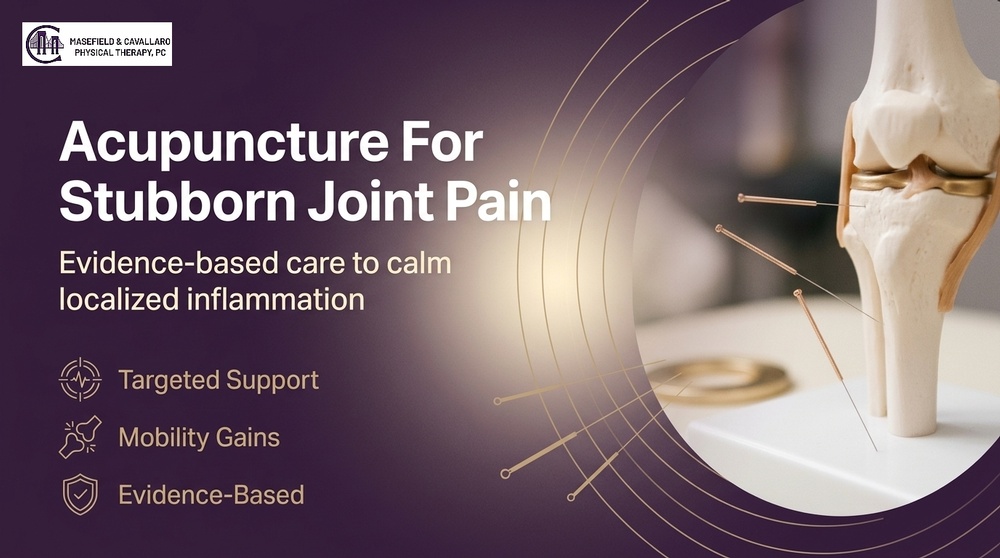
Why Clinical Studies Favor Acupuncture For Stubborn Joint Pain
- Masefield & Cavallaro Physical Therapy, PC
Categories: Acupuncture Clinic , Joint Health , Pain Management , Physical Rehabilitation
Persistent joint discomfort creates substantial disruption in your daily professional responsibilities and personal routine. When conventional pain relievers fail to produce lasting relief, you face diminished mobility, sleep disruption, and the frustration of managing unpredictable flare-ups. This cycle often impacts work productivity, limits physical activity, and erodes overall independence over time.
Many individuals find that pharmaceutical management alone only masks underlying symptoms rather than addressing localized biomechanical irritation. Relying strictly on systemic medication can also produce unwanted side effects, leaving you searching for reliable, non-surgical pathways that restore everyday function. Investigating comprehensive acupuncture services offers a proven clinical avenue to interrupt this persistent cycle and regain lasting physical ease.
Modern clinical research provides clear physiological evidence supporting this methodology. By understanding the rigorous medical trials examining traditional point stimulation, you can make informed decisions regarding your care pathway. Scientific literature demonstrates that targeted therapy reduces inflammation, calms central nervous system sensitivity, and promotes long-term joint health.
The Neurobiological Mechanisms Documented in Clinical Trials
Clinical investigations have systematically evaluated how the insertion of hair-thin filiform needles influences the human nervous system. When a licensed practitioner applies this technique, specialized sensory fibers, including A-delta and C nerve fibers, register mechanical micro-stimulation. This peripheral input travels straight to your spinal cord and brain stem, triggering a cascade of beneficial biochemical responses that directly alter your perception of pain.
Scientific trials demonstrate that needle stimulation activates the body's descending pain-modulatory pathway. This biological system prompts the pituitary gland and midbrain to release endogenous opioids, including endorphins, dynorphins, and enkephalins. These naturally occurring chemical compounds bind directly to opioid receptors across your nervous tissue. They effectively dampen distress signals before those signals register fully in your conscious brain.
Research shows that pain management acupuncture therapy also alters local adenosine levels around the affected capsule. Adenosine functions as a potent natural biochemical agent that suppresses inflammation and calms overactive sensory receptors. This localized shift explains why you often experience an immediate drop in tissue tension following a precisely targeted clinical session.
Controlled laboratory assessments further reveal that repeated sessions promote sustained downregulation of spinal dorsal horn excitability. By calming these hyper-responsive pathways, the therapy trains your central nervous system to cease amplifying routine sensory inputs. This re-education of your neural pathways proves critical for individuals suffering from long-standing discomfort.
How Needle Therapy Mitigates Chronic Joint Inflammation
Chronic arthritic irritation involves a relentless cascade of pro-inflammatory cytokines that continuously degrade intra-articular cartilage. Research tracking synovial fluid markers indicates that specialized needle therapy actively suppresses several key inflammatory mediators, including tumor necrosis factor-alpha and interleukin-1 beta. This reduction in chemical irritants prevents continuous tissue damage within the joint structure.
Studies measuring systemic blood markers demonstrate consistent reductions in high-sensitivity C-reactive protein after structured treatment protocols. This anti-inflammatory influence provides several critical clinical benefits:
- Marked decreases in surrounding capsular edema and synovial fluid swelling.
- Noticeable reduction in morning stiffness, allowing you to begin your workday with greater ease.
- Prevention of secondary tendon and ligament irritation around weight-bearing joints.
- Enhanced microvascular circulation that delivers essential nutrients straight to healing connective tissues.
By dampening the inflammatory cycle, this intervention creates a regenerative biochemical environment inside the capsule. The reduction of inflammatory chemicals stops the ongoing sensitization of localized nociceptors. This biological shift enables your connective tissues to recover functional tolerance without relying solely on persistent pharmaceutical intervention.
Furthermore, clinical trials highlight an elevation in microcirculation around treated areas. Using thermal imaging and laser Doppler flowmetry, researchers observe enhanced blood flow to ischemic, tightly bound soft tissues. This surge in blood supply accelerates metabolic waste removal, clearing out stagnant byproducts that cause lingering soreness.
Comparing Clinical Trial Outcomes: Acupuncture Versus Conventional Modalities
Large-scale meta-analyses, including data analyzed by major international research consortia, have evaluated needle interventions against standard pharmaceutical approaches. Across dozens of rigorous randomized controlled trials involving thousands of subjects, participants receiving precise point stimulation reported superior functional mobility scores compared to those receiving routine care alone. These outcomes remain consistent across evaluations of knee, hip, shoulder, and spinal joints.
A critical revelation in modern joint research is the high efficacy of this modality when compared against placebos. In well-designed sham-controlled trials, true needle application demonstrated statistically significant gains in joint flexion, extension, and weight-bearing endurance. These findings prove that the clinical benefits extend far beyond a psychological expectancy effect.
When evaluating the longevity of clinical outcomes, systematic reviews indicate that functional gains persist for months after concluding a dedicated treatment series. While oral medications lose effectiveness the moment you cease ingestion, neuro-stimulation establishes a durable biological baseline. Your nervous system retains its calm, non-reactive state long after your active treatment visits conclude.
Additionally, clinical research frequently tracks adverse event profiles across care modalities. While non-steroidal anti-inflammatory medications carry documented risks to your gastrointestinal tract, renal system, and cardiovascular profile, clinical point therapy displays a remarkably clean safety record. You receive dependable relief without subjecting your body to recurring systemic toxicity.
Integrating Acupuncture Services into Orthopedic Rehabilitation
Clinical data strongly supports utilizing needle modalities as an adjunctive component within a structured orthopedic physical therapy program. When joint irritation flares up, surrounding muscles instinctively spasm to brace the vulnerable area. This compensatory muscle tightness restricts movement and complicates corrective therapeutic exercise.
By incorporating targeted needle therapy into your broader rehabilitation pathway, you systematically release deep muscular trigger points that standard stretching cannot address. Relieving this chronic muscular guarding restores balanced joint mechanics. As a result, you can execute progressive strengthening and range-of-motion exercises with substantially less discomfort.
A coordinated program ensures that multiple complementary therapeutic techniques work together to expedite your functional recovery:
- Initial needle stimulation calms localized joint pain and relieves surrounding muscular hypertonicity.
- Targeted manual therapy techniques gently restore passive accessory glide to the articular surfaces.
- Active stability training rebuilds neuromuscular control, protecting your joints against future physical stressors.
- Functional movement re-education ensures safe transitions back into demanding work routines and active recreational pursuits.
Clinical trials confirming the benefits of combined modalities show faster discharge times and superior functional gains compared to isolated exercise programs. Addressing both the neural processing of pain and structural muscular weaknesses produces a synergistic effect. This balanced clinical strategy provides the definitive support your body requires for durable, daily stability.
Long-Term Functional Mobility and Cartilage Preservation Evidence
Sustained functional independence demands ongoing protection of healthy intra-articular cartilage surfaces. Long-term observational studies show that patients who utilize needle interventions exhibit slower radiological progression of degenerative joint changes over multi-year observation periods. By restoring normalized movement patterns, you distribute weight evenly across cartilage surfaces, reducing uneven mechanical wear.
Chronic pain fundamentally alters your walking mechanics and everyday movement strategies. When you unconsciously limp or alter your posture to protect a painful joint, you inadvertently overload adjacent structures, creating secondary discomfort in your hips, lower back, or opposing limbs. Point stimulation relieves the primary source of pain, allowing you to restore natural, biomechanically sound movement habits.
Animal and human histology models indicate that consistent neuro-modulatory intervention promotes the expression of type II collagen and essential proteoglycans within articular structures. These structural proteins form the foundational matrix of resilient cartilage, giving your joints the shock-absorbing capacity needed to handle demanding physical tasks. This structural preservation supports an active lifestyle, helping you preserve personal independence across every stage of life.
Patient-reported outcome measures in clinical registries consistently document improvements in key activities of daily living. Individuals report marked enhancements in climbing stairs, sitting for prolonged work meetings, driving, and participating in family recreational activities. By choosing evidence-supported care, you actively protect your joints and secure your physical capabilities for years to come.
Securing Your Personalized Path Toward Lasting Joint Comfort
Addressing persistent joint distress requires an evidence-based approach that respects the complex neurological and biomechanical drivers of your condition. Clinical studies demonstrate that targeted needle application provides profound relief, curbs damaging joint inflammation, and integrates smoothly into structured orthopedic recovery plans. Stepping away from temporary fixes allows you to achieve real, lasting structural progress.
You can begin your recovery journey today by scheduling a comprehensive evaluation with experienced clinical professionals who understand modern rehabilitation protocols. Send your questions directly to Administration@mcphysicaltherapy.com to discuss your specific symptoms and explore how a dedicated, multi-modal care plan can restore your mobility, reduce daily discomfort, and help you return to the active life you enjoy.