
Why Do Practical Sports Injury Treatment Plans Fail Athletes?
- Masefield & Cavallaro Physical Therapy, PC
Categories: physical therapy , rehabilitation , Athletic Recovery , Sports Medicine
You dedicate countless hours to perfecting your craft on the field or court. When an injury disrupts your momentum, you expect a clear path back to peak performance. Unfortunately, many practical sports injury treatment plans fall remarkably short of expectations. Athletes often find themselves stuck in a cycle of lingering pain and restricted mobility. This stagnation happens because standard rehabilitation protocols frequently treat the symptom rather than addressing the underlying mechanical failure.
Finding a reliable Sports Medicine Clinic makes a significant difference in your recovery trajectory. You need a facility that understands the high physical demands of athletic competition. Standardized exercise sheets and brief consultations rarely provide the depth of care required for full functional restoration. You require a comprehensive evaluation to pinpoint exact muscular imbalances and joint restrictions. A generic approach leaves you vulnerable to a secondary injury the moment you step back into competitive play.
Effective sports injury treatment requires a highly individualized strategy. A successful rehabilitation program must bridge the gap between basic clinical recovery and elite athletic performance. You must demand a plan that progressively loads your tissues while maintaining strict safety parameters. The goal is not simply to eliminate pain while resting. You need a structured progression that rebuilds your strength, agility, and confidence under competitive stress.
The Disconnect Between Generic Protocols and Athletic Demands
Many rehabilitation plans fail because they rely heavily on standardized protocols. These generic roadmaps assume every ankle sprain or shoulder impingement heals at the exact same rate. You know firsthand that your body responds to stress and recovery differently than anyone else. When a physical therapist applies a rigid template to your unique injury, they ignore your specific athletic requirements. This oversight leads to a frustrating plateau in your recovery process.
Your sport demands specific movement patterns and energy systems. A distance runner requires entirely different biomechanical support than a competitive weightlifter. If your sports injury treatment fails to account for these specific demands, you will not regain your competitive edge. Rehabilitation exercises must mimic the forces you will encounter during actual competition. Basic range of motion drills simply do not prepare your body for the explosive movements required in competitive sports.
Additionally, generic plans often lack the necessary progressive overload. You need a program that continually challenges your muscular and cardiovascular systems. When therapy sessions become repetitive and unchallenging, your physical adaptations stall completely. Your tissues must experience controlled stress to rebuild stronger and more resilient than before the injury.
A successful approach requires your rehabilitation team to deeply understand your specific athletic goals. They must analyze your sport, your position, and your typical training volume. This detailed analysis allows them to construct a recovery timeline that aligns with your competitive schedule. You should always feel that your treatment directly translates to your performance on the field. Without this functional connection, your rehabilitation remains incomplete and ineffective.
Overlooking the Mechanics of Tissue Healing and Load Management
Tissue healing follows a very specific biological timeline. Many practical plans fail because they either push you too hard early on or hold you back when you need progression. You must navigate the delicate balance of load management to optimize your recovery. Pushing inflamed tissues beyond their capacity causes setbacks and chronic pain. Conversely, underloading healing ligaments results in weak, disorganized scar tissue that cannot handle athletic stress.
Proper load management requires continuous assessment and modification. Your physical therapist should constantly evaluate your response to specific exercises and modalities. If you experience swelling or sharp pain after a session, the load must be adjusted immediately. You cannot simply power through rehabilitation pain the way you might push through a tough workout. This misguided mentality often turns a minor strain into a season ending tear.
Integrating evidence based milestones into your recovery plan is nonnegotiable. You need objective measurements to determine when it is safe to progress to the next phase of rehabilitation. These milestones might include specific strength ratios, joint mobility degrees, or pain free movement patterns. Relying solely on a calendar timeline is a massive mistake in sports rehabilitation. Your body dictates the pace of recovery based on how well it adapts to the prescribed therapeutic stress.
You must also consider the impact of external factors on your tissue healing. Sleep quality, nutrition, and psychological stress all play significant roles in your recovery timeline. A comprehensive plan addresses these variables to create an optimal environment for physical repair. When your care team ignores these holistic elements, they severely limit your potential for a full recovery. You need a strategy that supports your body both inside and outside the clinic.
The Missing Role of Manual Therapy for Sports Injuries
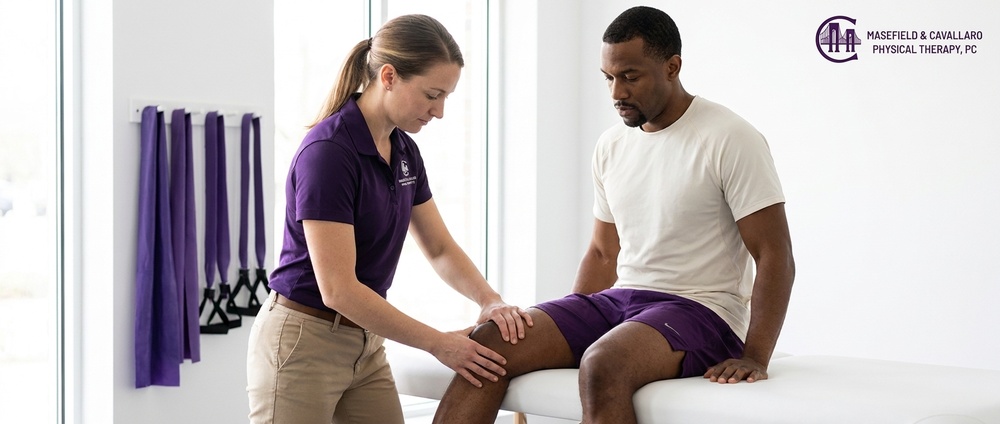
Exercise alone is rarely enough to resolve complex athletic injuries. A major reason many plans fail is the glaring absence of hands on intervention. Manual therapy for sports injuries serves as a foundational component of effective rehabilitation. Your muscles, fascia, and joints often require physical manipulation to restore proper alignment and mobility. Without this targeted intervention, you may develop compensatory movement patterns that lead to secondary injuries.
Skilled physical therapists use manual techniques to break down restrictive scar tissue. When you suffer a muscle tear or ligament sprain, your body lays down collagen fibers haphazardly. This chaotic healing process creates stiff, inflexible tissue that restricts your range of motion. Targeted soft tissue mobilization helps realign these fibers to improve flexibility and reduce localized pain. You will notice a significant difference in your joint mechanics after receiving expert manual intervention.
Joint mobilization is another essential aspect of manual therapy. Sometimes, the capsule surrounding your joint becomes tight and restricted following an injury or surgery. Your therapist can apply precise, graded pressures to the joint to restore its normal gliding motion. This restored mechanics allows you to perform your strengthening exercises with proper form. Attempting to build strength on top of a restricted joint is a recipe for chronic dysfunction.
You should also seek out clinics that integrate complementary modalities like massage and acupuncture. These therapies work synergistically with manual physical therapy to accelerate your healing process. Acupuncture can help modulate pain signals and improve localized blood flow to damaged tissues. Massage therapy reduces muscle tension and promotes relaxation throughout your nervous system. Combining these hands on approaches ensures a highly effective and well rounded recovery experience.
Failing to Integrate Comprehensive Sports Injury Support Systems
Recovery does not happen in a vacuum. A successful return to play requires a robust network of sports injury support. Many athletes fail to reach their goals because they are left to navigate the process entirely alone. You need a coordinated team of professionals communicating clearly about your progress and setbacks. This team might include your orthopedic surgeon, physical therapist, acupuncturist, and athletic trainer.
Clear communication prevents conflicting advice and overlapping treatments. When your providers operate in silos, you often receive mixed messages about your restrictions and capabilities. A unified approach ensures everyone understands your specific functional goals and current limitations. This cohesive strategy allows for seamless transitions between different phases of your recovery. You should never have to act as the messenger between your various healthcare providers.
Education is a massive component of proper sports injury support. You need to understand exactly why you are performing specific exercises and how they benefit your recovery. When therapists take the time to explain the biomechanics behind your injury, you become an active participant in your care. This knowledge empowers you to make smart decisions during your independent workouts and daily activities. Ignorance regarding your own body is a significant barrier to long term athletic success.
In addition, psychological support plays a massive role in athletic rehabilitation. Sidelining an athlete often leads to frustration, anxiety, and a loss of identity. Your care team should acknowledge these mental hurdles and provide strategies to maintain your focus and motivation. Setting small, achievable goals helps you build confidence as you progress through your treatment plan. A positive mindset directly influences your physical ability to heal and perform.
Premature Discharge and the Absence of Return to Sport Testing
The most dangerous phase of rehabilitation often occurs right at the very end. Many generic plans discharge athletes the moment they achieve basic, pain free daily function. Walking up the stairs without pain does not mean you are ready to sprint, cut, or tackle. Premature discharge is the leading cause of reinjury among competitive athletes. You need a rigorous testing protocol to bridge the final gap between clinical rehabilitation and live competition.
Return to sport testing involves highly specific, objective assessments of your physical capabilities. Your therapist must evaluate your power output, agility, and neuromuscular control under fatigue. These tests expose any lingering weaknesses or hesitations that could compromise your safety on the field. If you cannot pass these objective benchmarks, you are simply not ready to resume full athletic participation. Guessing about your readiness is an unacceptable risk to your long term health.
Fatigue testing is particularly important in this final phase. Many athletes perform perfectly during the first few minutes of a drill but fall apart when they get tired. Your neuromuscular system must be trained to maintain proper mechanics even when exhausted. A comprehensive testing protocol pushes your cardiovascular and muscular systems to their limits in a controlled environment. This rigorous evaluation ensures your body can handle the unpredictable demands of a real game.
Finally, a proper discharge requires a detailed maintenance program. Your vulnerability does not magically disappear the day you are cleared to play. You must continue performing specific preventative exercises to maintain your newly acquired strength and mobility. A dedicated maintenance plan empowers you to manage your own physical health independently. This ongoing commitment to self care is the ultimate key to enjoying a long, healthy athletic career.
Navigating the complexities of athletic rehabilitation requires a highly strategic and individualized approach. You cannot afford to waste your time and energy on generic protocols that ignore your specific physical demands. Achieving true functional restoration means demanding a plan that integrates precise load management, expert manual interventions, and rigorous objective testing. By prioritizing evidence based care and comprehensive support systems, you position yourself for a safe and confident return to your active lifestyle. Your body deserves a rehabilitation strategy that works just as hard as you do on the field.
Taking the next step toward a pain free, fully functional life begins with an accurate assessment of your current physical state. You need a team that aligns your therapy with your specific recovery timelines and athletic goals. Reach out today to discuss your unique situation and begin building a highly effective rehabilitation strategy. Contact Administration@mcphysicaltherapy.com to schedule your comprehensive evaluation and start your journey back to peak performance.