
How Practical Vestibular Therapy Resolves Hidden Dizziness Symptoms
- Masefield & Cavallaro Physical Therapy, PC
Categories: physical therapy , Balance Disorders , Dizziness Relief , Vestibular Therapy
You manage a demanding schedule filled with professional obligations and personal commitments. Unpredictable episodes of dizziness introduce significant vulnerabilities into your daily routine. This physical instability disrupts your focus and compromises your overall productivity. You might initially attribute these sensations to fatigue or temporary stress. However, persistent dizziness often points to deeper mechanical issues within your body. These hidden symptoms require immediate clinical attention to prevent long-term functional decline.
A sudden bout of vertigo severely limits your ability to operate safely in your environment. You may experience a spinning sensation that forces you to halt all activities. Ignoring these warning signs forces your body to compensate in unhealthy ways. This compensation leads to muscle tension, joint strain, and chronic fatigue. The root cause frequently involves complex miscommunications between your visual systems and your inner ear. You need a systematic, evidence-based strategy to correct these underlying mechanical failures.
Achieving a permanent resolution demands highly specialized clinical expertise. Partnering with a comprehensive Rehabilitation Center gives you access to advanced diagnostic protocols. You can leverage specific vestibular therapy techniques to recalibrate your internal balance systems. This targeted intervention directly addresses the hidden deficits causing your distress. You will systematically rebuild your physical confidence through guided, progressive movements. This proactive approach ensures you can navigate your demanding lifestyle without the constant threat of sudden imbalance.
Understanding the Root Causes of Your Imbalance
Your body relies on a sophisticated network of sensors to maintain physical equilibrium. The vestibular system acts as the central command center for this network. It resides deep within your inner ear and constantly communicates with your brain. This system detects changes in head position and spatial orientation. When this communication network experiences an interruption, you feel an immediate sense of disorientation. You must understand how these microscopic structures dictate your daily stability.
Small calcium carbonate crystals naturally exist within specific chambers of your inner ear. These crystals occasionally dislodge and migrate into fluid-filled semicircular canals. This migration sends false signals to your brain regarding your physical movement. Your brain struggles to reconcile these false signals with what your eyes actually see. This sensory conflict generates the intense spinning sensation known as vertigo. You require precise clinical maneuvers to relocate these microscopic particles back to their proper position.
Vestibular therapy provides a highly effective methodology for resolving this sensory conflict. Your physical therapist will conduct a thorough evaluation of your eye movements and balance reactions. This evaluation isolates the exact canal causing your specific symptoms. You receive a structured treatment plan based directly on these clinical findings. The therapy focuses on retraining your central nervous system to process spatial information correctly.
Consistent application of these techniques accelerates your recovery timeline. You learn how to manage your symptoms actively rather than waiting passively for relief. The clinical process demystifies the frightening sensations associated with severe dizziness. You gain immediate control over your physical responses through education and guided practice. This foundational understanding sets the stage for advanced rehabilitation exercises.
Executing Targeted Vestibular Rehabilitation Exercises
The core of your recovery relies on specific, movement-based interventions. Vestibular rehabilitation exercises serve as the primary mechanism for restoring your equilibrium. These exercises intentionally provoke mild symptoms in a controlled clinical environment. You expose your nervous system to these triggers to build long-term tolerance. This systematic exposure forces your brain to adapt and find new pathways for maintaining balance. You must commit to this structured progression to achieve lasting results.
Your clinical program will incorporate several distinct categories of therapeutic movement.
- Gaze Stabilization: You practice keeping your eyes focused on a stationary target while moving your head. This process strengthens the reflex connecting your visual and vestibular systems.
- Habituation Training: You repeatedly perform specific movements that typically trigger your dizziness. This repetitive exposure gradually decreases your brain's negative response to the stimulus.
- Postural Control: You engage in activities designed to improve your overall physical steadiness. These exercises challenge your center of gravity under various environmental conditions.
- Canalith Repositioning: You undergo guided physical maneuvers to clear debris from your inner ear canals. This direct mechanical intervention often provides immediate relief from acute vertigo.
You will perform many of these exercises under the direct supervision of your physical therapist. The clinical setting ensures you execute each movement with perfect form and maximum safety. Your therapist monitors your physiological responses and adjusts the intensity of the session accordingly. This real-time feedback loop prevents unnecessary discomfort while pushing your limits optimally. You build physical resilience through this carefully calibrated approach.
Your success also depends heavily on your independent commitment to the program. You will receive a detailed schedule of exercises to perform at home between clinical visits. Strict adherence to this home program maintains the momentum of your central nervous system adaptation. You must track your daily progress and report any changes in your symptom frequency. This collaborative effort between you and your therapist ensures a rapid return to optimal function.
Optimizing Your Stability Through Balance Therapy for Dizziness
Resolving internal ear dysfunction represents only the first phase of your complete recovery. You must also address the secondary physical deficits caused by prolonged dizziness. Balance therapy for dizziness focuses on strengthening the muscular systems that keep you upright. Your body naturally adopts rigid, defensive postures when you feel chronically unstable. This muscular stiffness restricts your normal range of motion and increases your risk of falling. You need targeted balance interventions to break this cycle of physical guarding.
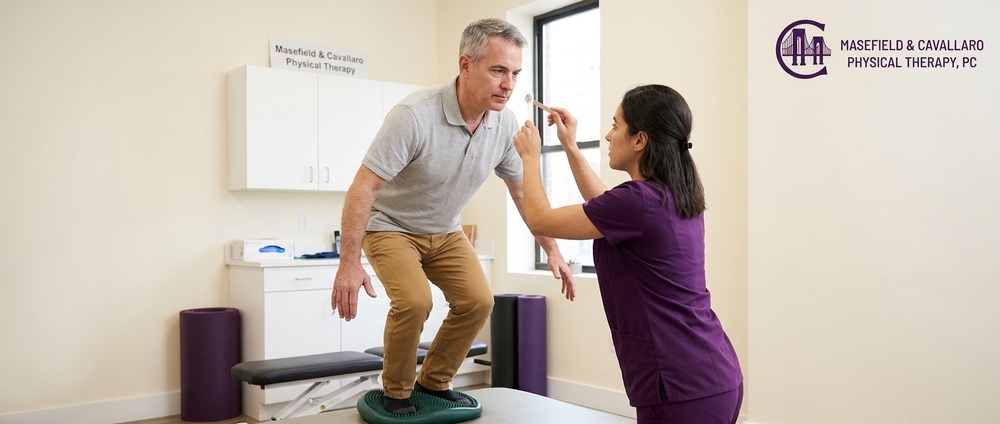
Your therapy sessions will challenge your proprioceptive awareness in a safe environment. Proprioception refers to your body's ability to sense its position in space without visual input. You will practice standing on uneven surfaces like foam pads or specialized balance boards. These unstable surfaces force your ankles, knees, and hips to make rapid micro-adjustments. You train your lower extremities to react instinctively to unexpected changes in terrain. This reactive training directly translates to improved safety during your daily activities.
Visual reliance often becomes a significant problem when your vestibular system fails. You subconsciously start depending entirely on your eyesight to maintain an upright posture. This over-reliance causes severe disorientation when you navigate poorly lit environments. Your therapist will introduce exercises that systematically reduce your dependence on visual cues. You might perform specific balancing tasks with your eyes closed or while wearing specialized goggles. This sensory deprivation forces your brain to trust your internal balance mechanisms once again.
Dynamic balance training prepares you for the unpredictable nature of real-world environments. You will practice walking while simultaneously turning your head or tracking moving objects. These dual-task exercises simulate the complex demands of navigating crowded streets or busy workplaces. You learn to maintain your center of gravity while your attention is divided. This advanced stage of therapy ensures you can return to your active lifestyle with complete confidence. You will no longer need to restrict your movements out of fear.
Leveraging a Comprehensive Clinical Approach
Isolated treatments rarely provide a permanent solution for complex balance disorders. You benefit immensely from a coordinated approach to your physical rehabilitation. Your vestibular symptoms often intersect with other orthopedic or muscular issues. For example, chronic dizziness frequently leads to severe tension in your cervical spine. You might develop debilitating neck pain as a direct result of trying to keep your head perfectly still. A comprehensive clinic addresses all these interconnected symptoms simultaneously.
Accessing multiple therapeutic modalities under one roof streamlines your recovery process. You might receive manual therapy to release the muscular tension in your neck and shoulders. This hands-on intervention improves your cervical mobility and reduces headache frequency. Your physical therapist can seamlessly integrate these orthopedic treatments with your vestibular protocols. You experience a compounding effect when all your physical limitations receive focused attention. This holistic methodology accelerates your timeline for returning to full functional capacity.
Adjunctive therapies can also play a significant role in managing your overall symptom profile. You may explore options like acupuncture to help modulate your nervous system response. Targeted needle stimulation can reduce systemic inflammation and promote localized blood flow. Massage therapy offers another effective tool for managing the secondary muscle spasms associated with balance disorders. You maintain a higher degree of physical comfort throughout the most challenging phases of your rehabilitation.
Clear communication between your healthcare providers ensures you stay on the optimal path. Your physical therapist will coordinate directly with your referring physician or specialist. This collaborative network guarantees that your treatment plan aligns perfectly with your specific medical history. You never have to worry about conflicting advice or disjointed care strategies. You receive a unified, evidence-based roadmap designed explicitly to restore your independence.
Tracking Your Functional Restoration Milestones
You need objective metrics to evaluate the success of your vestibular therapy program. Your physical therapist will utilize standardized testing protocols to measure your baseline capabilities. These initial assessments quantify your exact degree of impairment and fall risk. You will repeat these specific tests at regular intervals throughout your treatment plan. This data-driven approach provides tangible proof of your improving neurological function. You can clearly see how your hard work translates into measurable physical gains.
Functional milestones serve as the primary indicators of your clinical success. You might set a goal to walk through a busy grocery store without experiencing any nausea. Another milestone could involve driving your vehicle safely without dizzy spells triggered by passing traffic. Your therapy team structures your exercises to directly support these specific lifestyle objectives. You regain your autonomy step by step as you achieve each documented milestone. This targeted progression keeps you highly motivated during the recovery process.
Achieving your initial goals does not mean your rehabilitation journey is entirely complete. You must implement a long-term maintenance strategy to preserve your hard-earned stability. Your therapist will design a condensed version of your exercise program for ongoing use. You should integrate these specific movements into your regular weekly fitness routine. Proactive maintenance keeps your vestibular system sharp and highly responsive to environmental changes. You significantly reduce the likelihood of experiencing a severe symptomatic relapse.
Education remains your most powerful tool for long-term symptom management. You will learn how to identify the earliest warning signs of vestibular fatigue. This knowledge allows you to modify your activities before a minor issue becomes a major disruption. You understand exactly which exercises to deploy if you feel a slight return of your dizziness. You transition from being a patient to becoming an active manager of your own physical health. This empowerment ensures you maintain your active lifestyle for the long haul.
Overcoming chronic dizziness requires immediate action and dedicated clinical support. You do not have to accept physical instability as a permanent fixture in your life. Evidence-based vestibular therapy provides a clear, highly structured pathway out of the spinning and disorientation. You can systematically retrain your brain, strengthen your balance mechanisms, and eliminate the fear of falling. Committing to a comprehensive rehabilitation program restores your ability to function at your highest capacity. You deserve to navigate your daily environment with absolute confidence and physical security.
Taking the first step toward recovery involves scheduling a thorough professional evaluation. You need an expert clinical team to map out your specific mechanical deficits and design your recovery blueprint. Reach out directly to secure your initial consultation and begin your targeted therapy program. You can initiate this process by sending your inquiry to Administration@mcphysicaltherapy.com today. Your path to lasting physical stability and functional independence starts with this single, decisive communication.