
How Clinical TMJ Treatment Solves Persistent Jaw Tension Fast
- Masefield & Cavallaro Physical Therapy, PC
Categories: physical therapy , Jaw Pain Relief , Oral Facial Health , TMJ Treatment
Persistent jaw tension can interrupt your work focus, impair your ability to speak comfortably, and turn routine meals into painful ordeals. When you experience clicking sounds, tightness across the temples, or sudden locking in your jaw, the discomfort rarely stays confined to one spot. Left unaddressed, chronic stress on the temporomandibular joint radiates into painful neck stiffness, recurring morning headaches, and significant facial fatigue that drains your daily productivity.
Many professionals attempt to manage these symptoms with temporary fixes such as soft food diets, over-the-counter pain relievers, or nighttime mouthguards. While these options might offer fleeting relief, they fail to resolve the underlying muscular imbalances and mechanical joint misalignments driving the irritation. Seeking care at a dedicated Physical Therapy Clinic allows you to identify the true mechanical source of your discomfort, addressing joint dysfunction through targeted clinical protocols rather than superficial band-aids.
Clinical rehabilitation provides an evidence-based roadmap that directly restores joint mechanics and muscular equilibrium. Through structured physical therapy assessments, clinicians pinpoint whether your tension originates from joint capsule restrictions, hyperactive masticatory muscles, or postural deficits. By committing to comprehensive clinical TMJ treatment, you can resolve severe jaw pain relief challenges quickly, restore natural mouth opening range, and protect your long-term oral and cervical health.
Understanding the Anatomy Behind Jaw Pain Relief
The temporomandibular joint connects your lower jaw to the temporal bones of your skull, facilitating complex sliding and hinge movements required for chewing, yawning, and speaking. Between these bones lies a delicate fibrocartilaginous disc designed to absorb shock and guide smooth articulation. When your jaw muscles tighten excessively or pull unevenly, this protective disc can displace, causing friction, inflammation, and localized joint strain.
Surrounding muscle groups, including the masseter, temporalis, and pterygoid muscles, work in precise coordination during every jaw movement. When one muscle group becomes chronically hypertonic, it forces the entire joint complex out of balance. This mechanical asymmetry rapidly triggers joint inflammation and limits your normal range of motion, making it uncomfortable to open your mouth fully or chew firm foods.
Furthermore, the temporomandibular joint shares complex neurological pathways with the upper cervical spine. Irritation within the jaw frequently refers discomfort upward into the temples and downward into the base of the skull. A thorough clinical evaluation analyzes these interconnected pathways, ensuring that treatment targets the accurate anatomical source rather than chasing diffuse regional aches.
By understanding how your jaw joints, disc alignment, and surrounding musculature interact, you can appreciate why passive rest alone rarely solves chronic tightness. Active clinical management stabilizes this delicate system, establishing the mechanical balance required for durable symptom reduction.
Targeted Clinical TMJ Treatment Protocols for Rapid Results
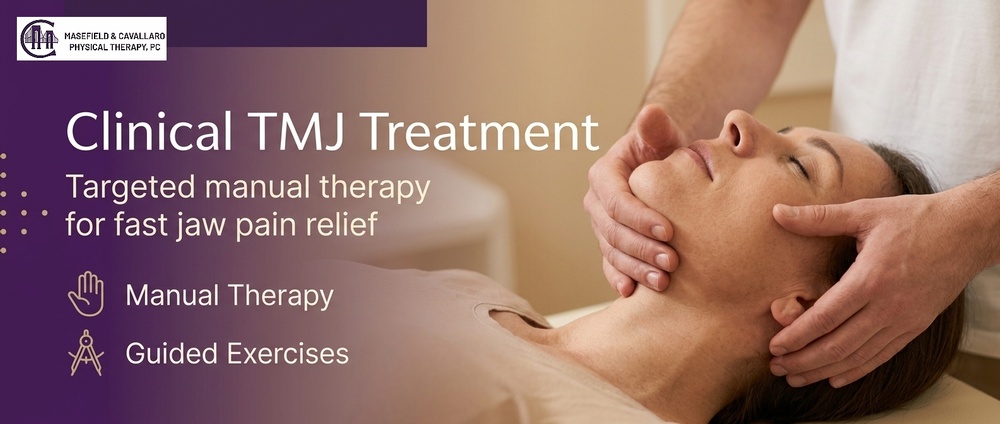
Clinical physical therapy relies on targeted, evidence-based interventions specifically engineered to calm inflamed joint tissues and release stubborn muscle spasms. Instead of generic suggestions, physical therapists employ hands-on manual techniques directly to the jaw and neck. These specialized procedures safely mobilize restricted joint capsules and release myofascial trigger points within the deep pterygoid and masseter muscles.
Therapists regularly combine intraoral and extraoral soft tissue mobilization to release chronic tension that external stretching cannot reach. By gently applying pressure inside the cheek along the pterygoid muscles, your therapist can deactivate persistent muscular knots that actively pull your jaw out of alignment. This direct approach provides noticeable relief within your initial sessions.
Alongside manual therapy, clinical care integrates therapeutic modalities to control acute inflammation and accelerate tissue recovery. Modalities such as ultrasound, targeted electrical stimulation, or complementary acupuncture treatments can help soothe hyperactive nerve endings and relax spastic muscle fibers. These techniques prepare your jaw tissues for subsequent corrective movement training.
A structured clinical plan continually monitors your progress, adjusting the intensity of manual techniques as your tissues heal. This responsive approach prevents flare-ups while systematically guiding your jaw back to pain-free, symmetric function.
Restoring Mobility with Prescribed TMJ Exercises for Jaw Pain
Active movement retraining forms the backbone of sustained recovery, ensuring that your jaw muscles learn to open and close along an even track. When you practice clinical TMJ exercises for jaw pain, you retrain neuromuscular control, stabilize hypermobile joint components, and gently lengthen shortened tissues. Performing these movements under clinical direction ensures you do not inadvertently aggravate delicate ligaments.
Your clinician will introduce progressive exercise categories designed to address your individual mobility restrictions:
- Controlled Opening Drills: Exercises that train your tongue to rest on the roof of your mouth while you open, preventing excessive anterior translation of the condyle.
- Isometric Resistance Training: Gentle static contractions against light hand resistance that strengthen weak stabilizing muscles without straining the joint capsule.
- Lateral Deviation and Protrusion Tracking: Guided movements that restore smooth side-to-side and forward jaw alignment during functional tasks.
- Cervical Retraction Progressions: Postural corrective drills that reposition the head over the shoulders, directly reducing tension on anterior neck and jaw tissues.
Consistency and precision remain paramount when performing these prescribed exercises. Rushing through repetitions or applying excessive force can irritate the joint capsule, which is why your therapist monitors your mechanics closely before advancing your home program. Practicing precise motor control allows your joint to glide smoothly without audible clicking or painful deviation.
Over time, these rehabilitative exercises build resilient neuromuscular pathways that keep your jaw balanced even during stressful periods. By reinforcing proper movement patterns, you actively defend against the return of persistent tension.
The Critical Link Between Cervical Posture and Jaw Mechanics
Your jaw position does not exist in isolation; it functions as an extension of your cervical spine and upper body posture. When you sit with a forward head posture at your desk, your skull shifts anteriorly, placing abnormal tension on the hyoid muscles and anterior neck structures. This biomechanical shift pulls your lower jaw backward, compressing the retrodiscal tissues inside the temporomandibular joint.
This persistent backward pull forces your masseter and temporalis muscles to work significantly harder just to keep your mouth closed. Over an eight-hour workday, this compensatory effort leads to profound muscular fatigue, localized trigger points, and intense temporal headaches. Correcting cervical posture is therefore fundamental to eliminating jaw strain.
Clinical physical therapy programs systematically evaluate your spinal alignment, scapular stability, and thoracic mobility alongside your jaw opening measurements. By restoring proper thoracic extension and strengthening deep cervical flexors, therapists take the mechanical load off your jaw. This postural correction immediately decreases the compressive forces exerted on your temporomandibular disc.
Addressing the entire kinematic chain ensures that your jaw pain does not return once you resume demanding work schedules. Comprehensive posture re-education provides a stable structural foundation that supports lasting facial relaxation.
Long-Term Management and Habit Modification Strategies
Sustained freedom from jaw pain requires identifying and modifying daytime functional habits that silently overwork your temporomandibular joints. Many individuals unknowingly clench their teeth during focused desk work, rest their chin heavily in their hands, or hold their mobile phone between their ear and shoulder. Eliminating these repetitive strains plays a massive role in protecting your physical therapy gains.
Your physical therapist will help you establish resting jaw posture rules that keep your facial muscles relaxed throughout the day:
- Maintain the Rest Position: Keep your lips closed, teeth slightly apart, and tongue resting gently on the palate behind your upper front teeth.
- Avoid Parafunctional Habits: Stop chewing gum, biting on pens, or gnawing on fingernails, all of which place heavy repetitive loads on joint surfaces.
- Implement Ergonomic Corrections: Position computer monitors at direct eye level to prevent forward head drift and screen slouching.
- Practice Conscious Relaxation Cues: Set periodic daytime timers to check for subconscious jaw clenching, deliberately exhaling to drop your shoulders and unclamp your teeth.
Modifying dietary habits during recovery also spares your healing joint tissues from unnecessary trauma. Temporarily avoiding tough meats, crusty breads, and sticky candies allows inflamed retrodiscal tissues to recover without recurrent microtrauma. As muscle balance improves, you can progressively reintroduce these foods with confidence.
Integrating these simple habit modifications into your daily routine safeguards your recovery investment. You gain total control over your physical well-being, avoiding the recurring cycle of pain and muscular tension.
Reclaiming Comfortable Jaw Function and Daily Ease
Experiencing chronic facial tension, painful chewing, and persistent morning headaches does not have to be your normal state. Through accurate clinical diagnosis, skilled hands-on joint mobilization, and guided rehabilitative exercises, you can resolve the root drivers of temporomandibular dysfunction. Professional physical therapy provides the targeted structure, accountability, and clinical precision necessary to restore painless jaw mobility quickly.
Taking action early prevents minor joint irritation from developing into permanent disc damage or chronic myofascial pain syndromes. If you are ready to eliminate jaw tension and restore fluid, comfortable movement, contact our clinical team at Administration@mcphysicaltherapy.com to schedule your comprehensive evaluation and begin your journey toward lasting relief.